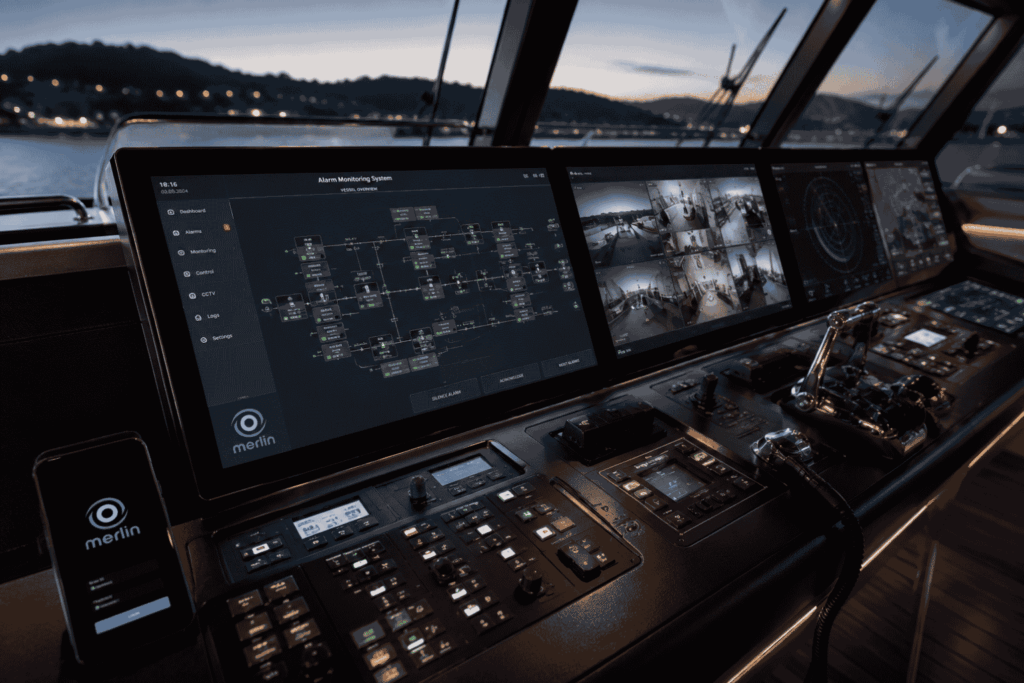
With ROMV, all relevant on-board systems are monitored centrally, critical conditions are detected at an early stage and reliably reported. This ensures you retain full control on board at all times. Safe and class-certified.
On board a ship, countless technical systems must be reliably monitored at all times and reported immediately in the event of an emergency. ROMV designs, integrates and programmes alarm, monitoring and control systems (AMS) that centrally monitor mechanical, electrical and operational systems. For maximum safety and smooth ship operations.
What is an alarm, monitoring and control system?
An Alarm Monitoring System (AMS) centrally monitors the status of safety-critical and operational equipment on board, such as the main engine, generators, pumps, tanks and fire-extinguishing systems. Deviations from normal values are detected, prioritised and reported as alarms to the bridge, the engine control room or mobile devices. In combination with a control level, many systems can also be remotely controlled and automated directly. The AMS is often part of a higher-level Integrated Automation System (IAS).
◉ Overview of services
Our services in the field of alarm and surveillance systems
We support your project from the system design stage right through to the final handover of the plant.
Planning & System Design
We draw up the automation concept for your AMS, defining alarm priorities, data points and system architecture. Tailored to the type of vessel, classification society and the shipping company’s requirements.
Hardware and software integration
We supply and integrate the necessary hardware (I/O modules, processors, operator stations) as well as the associated software for visualisation, alarm systems and data logging.
Integration of on-board systems
Mechanical, electrical, fuel and safety systems are connected to the AMS via suitable interfaces (e.g. Modbus, NMEA, CAN bus) and displayed centrally.
Commissioning & Class Certification
We commission the system, test all alarm and control functions, and oversee the acceptance inspection carried out by the relevant classification society.
◉ Why ROMV
Your benefits at a glance
As a specialist firm in marine automation, ROMV regards alarm and monitoring systems as safety-critical core components of ship operations.
✓ Centralised overview of all safety- and operations-related systems on board
✓ Early alerts in the event of deviations, enabling rapid intervention
✓ Systems certified by classification societies in accordance with the specifications of recognised classification societies
✓ Scalable systems – from a simple alarm system to an integrated automation system (IAS)
✓ Reduced staffing costs thanks to centralised monitoring rather than manual checks
✓ A single point of contact from the planning stage right through to final acceptance
Our alarm, monitoring and control systems are designed and implemented in accordance with internationally recognised standards, including the IMO’s SOLAS regulations and the rules and regulations of recognised classification societies. In this way, we ensure that your installation can be operated in a class-compliant, safe and properly documented manner.
◉ Areas of application & sectors
Our alarm and surveillance systems are used in the following areas, amongst others:
Yachts
Reliable AMS solutions for the central monitoring and control of all on-board systems. For safe operation and maximum comfort on board.
Ferries
High-performance AMS technology for the reliable monitoring and control of all on-board systems in high-frequency services.
Government/state vessels
Precision AMS technology for centralised control and protection of all on-board systems. For operations where reliability is paramount.
◉ Project workflow
This is how we handle your alarm, monitoring and control system project
Enquiries & Advice
Tell us about your vessel type and requirements, and we’ll advise you on suitable system solutions.
Planning
Development of the system architecture, list of data points and quotation.
Manufacturing & Installation
Installation of switchgear and control panels, cabling and fitting on board.
Programming & Integration
Integration of the on-board systems and configuration of alarm logic and visualisation.
Commissioning & Acceptance
Functional testing, documentation and support during the class acceptance process.
◉ QUESTION & ANSWER
Frequently Asked Questions about the Alarm, Monitoring and Control System (FAQ)
What is the difference between an AMS and an IAS?
An Alarm and Monitoring System (AMS) monitors and reports on the status of on-board systems. An Integrated Automation System (IAS) extends this to include comprehensive control functions and links several subsystems to form a central automation platform.
Which classification societies are supported?
We implement our systems in accordance with the specifications of DNV and other leading classification societies, amongst others – tailored to your vessel and your flag.
Can an existing alarm system be retrofitted or upgraded?
Yes, we inspect existing systems and upgrade or modernise them where necessary, for example whilst the vessel is in dry dock or as part of a fleet modernisation programme.
How long does it take to commission an alarm and surveillance system?
The duration depends on the scope of the system, the number of data points and the vessel’s availability. We coordinate the schedule closely with the shipyard and the shipping company to keep lay-ups as short as possible.
Reliable partners & friends
◉Would you like to find out more?
Please get in touch with us.
Would you like to find out more about ROMV, our MERLIN platform or our solutions for building and marine automation? We look forward to hearing from you.
Whether it’s a specific project, personalised advice or a technical enquiry, our experienced team will be happy to assist you personally.
Services
ROMV Building Automation
ROMV Building Smart measurement and control technology, room temperature control and fire safety for your property – optimised by our manufacturer-independent MERLIN software.